

Customers choose to buy from you for many reasons. Your product is just one of them.
Gee Ranasinha / March 29, 2009 / Business
[Updated April 2026]
From 1987 to 1992, I founded and ran a media production company. Commercial and advertising photography, mostly. We did press and billboard ads, calendars, annual reports, and I even directed a TV commercial. We worked with big-name clients such as Nestlé, BAT, Procter & Gamble, and Ford Motor Company. The business grew to over $1 million revenue – and that was with just four of us.
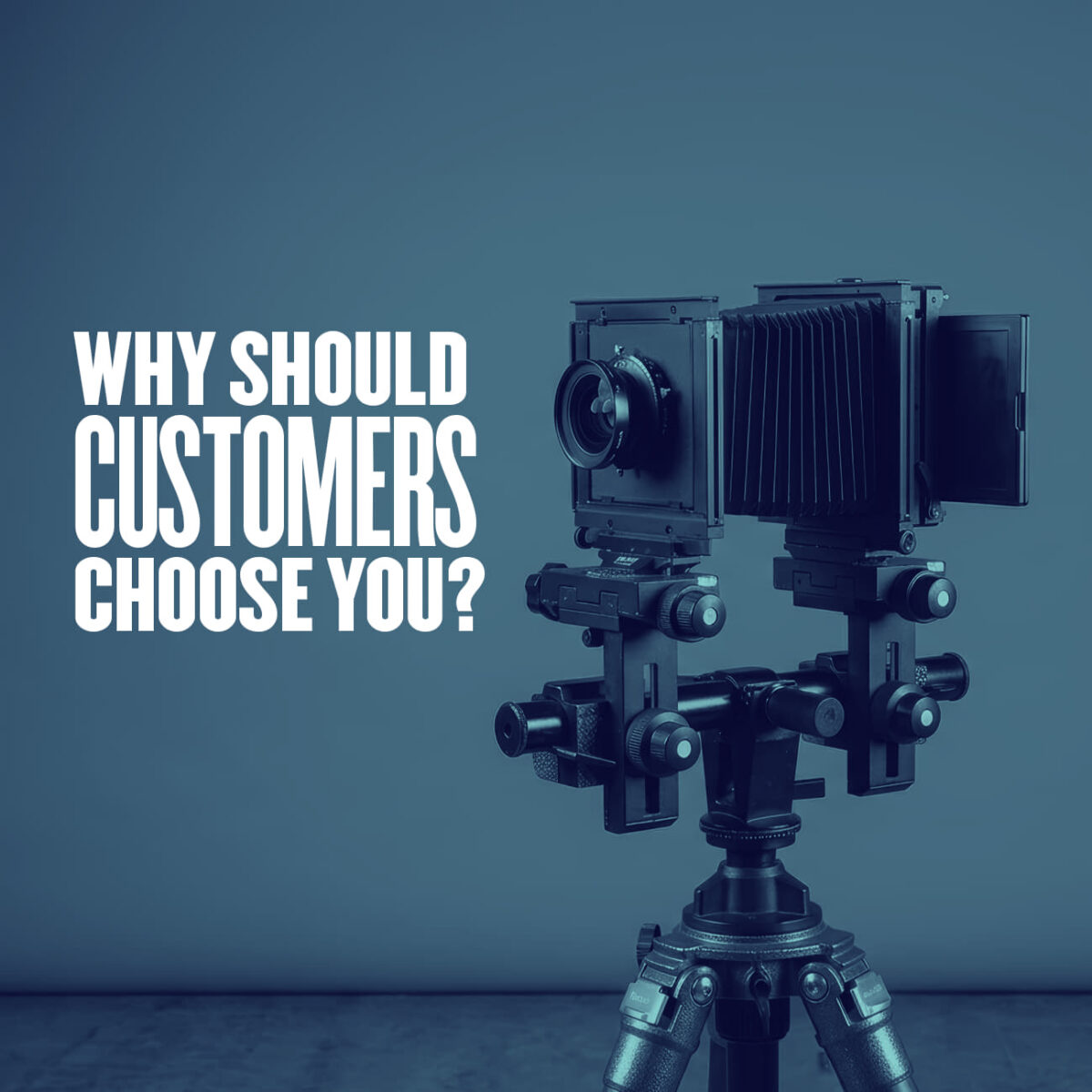
Over those five years I did some crazy things. Dangling ten feet below a helicopter, while it was flying maybe fifty feet above the sea (no drones in those days, you see). I remember manually retouching frame by frame a length of motion picture film to create a special effect, because the software to do it didn’t exist yet. I photographed fashion models, titans of business, politicians, and the occasional movie star. We shot in tropical rainforests, race circuits, and desert islands, but I was happiest when I was in the studio. I loved the control I had over every variable, light and shadow, color, composition, or set design. My favorite weapon of choice was a 5×4 or 10×8 view camera. My Sinar P2 remains one of my most treasured possessions, as it holds a lot of memories.
The thing is, I was never that great as a photographer.
OK, I wasn’t actually bad, but I certainly wasn’t awesome. My shots were technically competent, properly exposed (for film, remember) and were well lit and in focus when they needed to be. Agency art directors approved them. Clients approved them. But I knew there were people in the industry, my competitors, who were considerably better that I was. And yet the work kept coming, even as the early-90s recession slowly strangled everything around it and plenty of those more talented photographers were watching their brick-sized phones go quiet.
It took me a long time to understand why I carried on getting work, while some others had to call it day. It centered around how I worked, more than what I was actually producing.
What I was doing that I didn’t realize I was doing
Let me give you an example. At the time fashion shoots, by convention, were generally scheduled to kick off quite early in the morning – maybe 8am – since it would take time for models to be made up, clothes altered/tweaked/taped, and a 101 other things that happened well before a roll of 120 film would see the back of a Hasselblad. Location shoots would often begin earlier still, since we’d probably want to be ready to shoot at the golden hour.
All of the above seems perfectly reasonable, logical, and pragmatic…until you inject the human element. And not just humans, but fashion models. You see, the problem is that 8am is a concept most fashion models view somewhere between bewilderment and personal offense. Many fashion models only know one ‘8 o’clock’, and it’s not the one in the morning. Consequently, many of the images that came out of those morning shoots looked exactly like what they were: photographs of people who’d rather still be asleep.
After hanging around with fashion models for long enough (a tough gig, but someone had to do it) I got to know more about how these people lived, loved, and functioned. Many were night owls, only really booting up after around 10pm before getting something to eat, finding out where the new ‘it’ place to be seen was this week, then clubbing the rest of the night away. Which gave me my brainwave: why on earth are we scheduling photoshoots at a time of the day where the people in our photos are feeling their worst?
So instead of doing what everyone else was doing, I started scheduling fashion shoots to kick off at 9pm, which went on well into the night and often ended up with all of us hitting up some trendy nightspot until dawn. It took a bit of convincing with ad agencies (as well as model agencies) but after everyone saw the results of the first shoot, they were all clamoring to take the credit for this amazing idea. The models arrived at the shoot in good spirits, alert, and (this matters more than it might seem) feeling like someone had actually thought about their experience rather than just the production schedule. Clients kept coming back to us, but I don’t think it was because of the photos. Yes, the shots were probably a little better, but that was only part of it. It was that a shoot with Gee had a totally different vibe that a shoot with anyone else – and that was something people remembered.
Apart from evening fashion shoots, there were other things I’d do that others wouldn’t. After delivering whatever the agency’s campaign brief asked for, I’d spend my own time reworking the shot in a direction I thought would land better for the client’s actual message. The agency didn’t always choose my version, in fact that usually didn’t, but they now had an option they wouldn’t otherwise have had, and they registered that. As I continued to (unconsciously) break down the agency/supplier walls of responsibilities, I’d be trusted to sit in on internal strategy and planning meetings, invited to offer input on message development, art direction, or brand articulation. Sometimes I’d offer to work with junior art directors for free, helping them realize ad layouts and TV storyboards that never went anywhere. On more than one occasion I presented a large ad campaign pitch to a client on behalf of the agency – something unheard of then, as now.
Understand that I wasn’t doing any of this expecting anything in return. There was no Jab Jab Jab, Right Hook calculation running quietly in the background. I did all of these things because I found it personally interesting, and because the work was better when the people around me were in a position to do their jobs well. The side effect was a reputation that compounded faster than my technical ability probably warranted.
What I was doing, without having a name for it, was creating what today we’d refer to as moments of unexpected value. Things nobody had asked for, and nobody had a line item for. Small, deliberate actions that signaled I was paying attention and respect to the people in the room, rather than just the logical and rational brief on the table. As Steve Martin once put it: be so good they can’t ignore you, even though “good” in this context hasn’t actually got much to do with photography.
Why buyers choose you over someone more talented
Why should customers choose your business over a competitor? However you answer that question is what we’d call your competitive advantage. But the more useful question is how customers actually arrive at that choice, because it isn’t a purely logical process. If it were, ads would just be spec sheets and the vendor with the best numbers would win every contract.
Buyers decide based on a combination of rational criteria and something considerably harder to quantify. Emotionally connected customers are more than twice as valuable over their lifetime as customers who are merely ‘highly satisfied’. The implication is that merely being competent at doing what the customer expected us to do is a particularly fragile foundation on which to build a business.
You could be forgiven for thinking “emotional connection” in B2B sounds like consultancy-speak until you translate it into what it actually means in practice. It’s not charm, or at least it’s not only that. It has the client feeling like the person they hired is thinking about their specific situation, rather than simply processing their brief, which puts that person somewhere very different from a vendor on the approved supplier list we looked at when internally discussing budgets.
The cost nobody puts on the invoice
Many businesses, when they’re trying to understand why they’re losing clients or failing to convert prospects, go looking in the usual predictable places – pricing, messaging, competition, or whether they’re communicating clearly enough. These are worth examining, and sometimes the answer can be found in those kinds of things. But more often what’s actually happening sits in a layer that no-one’s looking at: the accumulated cost of working with them as a business. I’m not talking about pricing, I’m talking about the cognitive weight of dealing with a business that doesn’t bother to ‘get’ who we’re about. Every moment a client has to chase a response or quietly manage upward to their own leadership because something wasn’t handled as expected, none of that shows up on anywhere measurable. It just continues to accumulate in the background until, one day, the client decides that the work is fine but the relationship is tougher than it should be, and they start taking calls from competitors.
Buyers usually don’t make that decision consciously. The emotional response to a supplier tends to form before the rational evaluation catches up. People develop a feeling about whether working with someone is worth the effort, long before they can articulate why. A competitor who is less capable than we are, but made clients feel looked after, can end up winning. Since ‘exceeding customer expectations’ isn’t a field on our spreadsheet, it doesn’t get measured, so we blame the customer defection on them having some new feature, or price, or whatever.
The 9pm fashion shoot, reworking a shot off book, or sitting in on a strategy meeting weren’t part of anyone’s brief, and weren’t deliverables. They were, in fact, signals. They were a proxy in demonstrating I was paying attention to something beyond the scope of what I’d been contracted to do. And that, it turns out, is disproportionately powerful relative to the effort it requires.
Moments of delight that nobody asked for
What does ‘customer delight’ look like for your business? You probably don’t know – yet – because such business behavior doesn’t fit neatly into the usual customer-provider framework, and most businesses never think to cultivate it deliberately. Buyer referrals almost never come from “they delivered good work on time”. They come from “you simply have to work with these people – they’re awesome.” It’s about a feeling the client carries around that they want to pass on to someone they like. And that feeling gets created in exactly the moments we’re describing, the ones that sit outside the contract, outside the brief, outside any conventional measure of performance. It what branding is, in the most purist and truest sense of the word.
So is AI all, or part, of the solution? Probably not. It’s hard, perhaps impossible, to quantify “unexpected customer delight” to an algorithm. AI can help us produce more of many things, and there are plenty of tasks where that makes sense. But what AI can’t do is manufacture the thing we’re describing here. Scaling personalization is not the same as genuine attention. A system that generates a contextually appropriate follow-up email is doing something categorically different from a person who noticed something and decided it was worth saying. Human beings innately feel that difference, even if they can’t name it. I think that gap, in a world where most of our competitors are automating toward the generic, is only going to widen.
Making the commercial case for paying attention
If all of this sounds merely abstract, there’s a clear business case for doing this kind of thing. Acquiring a new client costs substantially more than retaining an existing one, somewhere between five and twenty-five to one, depending on the category. Most savvy business owners and senior managers are well aware of this, yet seem happy to continue to pour budget into acquisition while treating retention as something that will take care of itself if the work is good enough. Clients who feel the relationship returns something net positive, over and above simply “the deliverables are acceptable”, tend to be far less focused on whether the price went up, or the package size shrunk. Instead of building a comparison spreadsheet to use as evidence against us, they’re looking for reasons to stay.
The conflation of price and value runs through all of this. Price sensitivity in an existing client relationship is almost always a symptom of something else: the feeling that what they’re paying isn’t matched by what they’re getting back, including all the parts that don’t show up in the deliverable. Addressing the symptom with a discount is a blunt instrument that’s both expensive and temporary. Addressing the underlying feeling, by being the kind of business that creates those unexpected, unrequested moments of attention, is neither.
I still have the Sinar P2. It’s in my basement, not doing very much. But every time I look at it I’m reminded that the business it helped build wasn’t really built on photography at all. It was built on 9pm starts and unrequested shoots and strategy meetings I had no business attending. It’s a symbol of paying attention to the people in the room rather than just the job in front of me.
What are you doing to create those moments for your customers?
ABOUT THE AUTHOR

Gee Ranasinha is CEO and founder of KEXINO. He's been a marketer since the days of 56K modems and AOL CDs, and lectures on marketing and behavioral science at two European business schools. An international speaker at various conferences and events, Gee was noted as one of the top 100 global business influencers by sage.com (those wonderful people who make financial software).
Originally from London, today Gee lives in a world of his own in Strasbourg, France, tolerated by his wife and teenage son.
Find out more about Gee at kexino.com/gee-ranasinha. Follow him on on LinkedIn at linkedin.com/in/ranasinha or Instagram at instagram.com/wearekexino.
Recent articles:
Why Business Still Worships Effort (And How It’s Quietly Killing Strategy)

The “Brand vs. Activation” Debate Is a Capital Allocation Failure

How Behavioral Science Thinking Improves Marketing Effectiveness
Dark Social: The Hidden Conversations Marketers Can’t See

Marketing In A Recession: How To Weather The Storm

How To Convince A Marketing Skeptic