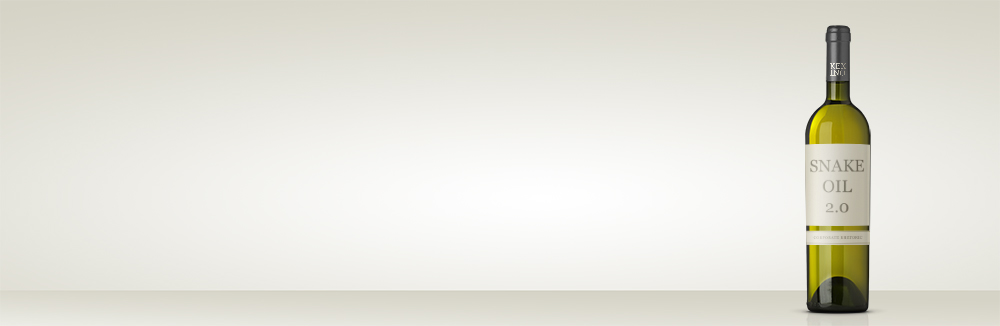
You’re NOT the best at what you do. If you were, you wouldn’t have to say it.
Gee Ranasinha / May 19, 2010 / Business
Marketers and business owners from Austin to Auckland seem to have collectively decided that the path to credibility was claiming as much of it as possible.
Nonsense phrases such as “Global leaders“, “World-class“, or “Unrivaled” have been repeated so often that we’ve stopped noticing them, which is probably the most dangerous thing about them. Because while we think we’re sounding cool and authoritative, these kinds of phrases are quietly eroding the credibility of everything else we say alongside them.
The Problem Is in the Words Themselves
There’s a reason “global leader” and “world-class” feel so weightless, and it has less to do with overuse than with what those words actually are. They’re abstract, in that they describe a general quality rather than a specific thing. Research from Wharton on linguistic concreteness found that concrete language, that’s words describing specific, tangible, observable things, consistently outperforms abstract language in building trust and comprehension with buyers. When a company says it’s “world-class“, there’s nothing that a buyer can picture in their minds, or can test. It’s a floating adjective asking to be believed on faith.
Compare “World-class implementation support” with “Our average client is fully onboarded in eleven days.” The second sentence describes something observable. A buyer can easily and tangibly compare it against a competitor’s number. The first sentence, in contrast, can’t be interrogated because it doesn’t actually say anything. Behavioral science describes this as the difference between a “high-construal” and “low-construal” message. High construal, the abstract kind, works well in investor pitches where we want to suggest scale and possibility. When we’re trying to convince a skeptical buyer that we can deliver on a specific problem, it works against us, because abstract language signals distance from the actual experience of doing the work. It sounds like someone who’s read about onboarding in a book, rather than someone who’s sat through several hundred of them.
Wharton professor Jonah Berger‘s analysis of hundreds of thousands of customer service interactions found that customers who engaged with concrete language spent 30% more time with the business in the following weeks. It might not be as sexy as using intangible superlatives, but concrete language signals attention. It implies the person speaking has actually encountered the situation they’re describing. Buyers are picking up the same signal from our copy, consciously or otherwise, and drawing conclusions we’re probably not aware of.
When Superlatives Become a Trust Tax
Related to this is a concept in Behavioral Science called signaling theory, which describes how the credibility of a claim is partly determined by how “costly” it is to make. Expensive signals, such as a TV or billboard ad, carry weight because they can’t be faked cheaply. “Global leader in enterprise solutions” costs nothing to write, which is one of the main reasons why buyers don’t believe it. If we were genuinely leading anything, we probably wouldn’t need to announce it in the second sentence of our homepage.
The problem compounds when we consider where buyers actually are by the time they read our website. B2B buyers today complete most of their independent research before they speak to us at all. According to 6sense’s Buyer Experience research, 81% of buyers had already selected a preferred vendor before initiating contact with any sales team. By the time they reach our homepage, they’ve already formed a working hypothesis about us and are looking to confirm it.
Most businesses are doing roughly what their competitors are doing, with marginal differences that matter far less than the marketing implies. Buyers understand this because they experience it in every category they purchase from. So when our messaging overclaims, the gap between what we say and what they already suspect becomes visible credibility damage. Research published in Harvard Business Review found that more than 80% of consumers consider trust a deciding factor in their purchase decisions, yet only 34% actually trust the brands they use. We’ve manufactured that gap ourselves, and then we spend budget trying to close it with more of the same messaging that opened it.
The Discount Gets Applied Before You’ve Finished Talking
When someone encounters a claim they think smells fishy, they don’t just reject that claim. They apply a general discount to the entire source. Whatever comes next, even something modest and accurate, gets filtered through the same skepticism. We’ve essentially told the buyer to trust us less at the exact moment we were trying to establish that they should. And we have no idea it’s happened, because the buyer never says anything. They just stop replying, and go elsewhere.
This is why overclaiming is corrosive in ways that are genuinely hard to measure. The conversion rate maths doesn’t tell us how many buyers quietly disqualified us during their research phase, before we ever had the chance to speak to them. The deal we didn’t win left no record. According to Forrester’s 2024 Buyers’ Journey Survey, 92% of B2B buyers start with at least one vendor already in mind, and 41% had already settled on a preferred vendor before formal evaluation began. Deals are being decided in a phase we’re largely invisible to. The version of us buyers encounter during that anonymous research window is doing more commercial work than we usually acknowledge, and absorbing more damage than we notice when it goes wrong.
Calling ourselves unrivalled, or a global leader, positions us as a business that either doesn’t notice how it sounds, or does notice and has decided to give it a go regardless. Buyers can distinguish between a business that’s confident and a business that’s compensating. The two things don’t read the same, even on a homepage trying to look identical to both.
The Honesty Arbitrage
Many businesses are caught in a collective action problem where everyone inflates their claims because they assume everyone else is doing the same, and they’re worried that honesty will read as modesty by comparison. The consequence of this marketing version of a Mexican Standoff is a market where every vendor sounds identical and superlatives have lost all communicative value, but nobody moves first. Which means the businesses that do move first get something worth having: genuine differentiation through being legible in a category where everyone else has become noise.
A survey of more than 13,000 adults across 14 countries found that 69% said a brand owning its mistakes was among the most effective trust-building behaviors available to it. Taking ownership of a mistake moved the trust needle most, which is a strange finding until you think about what it’s actually measuring. A business willing to say something that costs it reputationally is a business implying it doesn’t need every sentence to be flattering, which implies it has enough confidence in its actual quality to absorb the honesty (signally theory, again). That posture is rare, but buyers pick it up.
Trust is built through a demonstrated pattern over time. The 2024 Edelman Trust Barometer found that trust in US companies dropped nine points over ten years. That decline is the accumulated result of overpromising and underdelivering across thousands of brand interactions, spread over decades. The buyers we’re talking to have been trained by that environment. The marketing they’ve been exposed to throughout their careers made them skeptical, and they’re good pretty darn good at spotting and smelling the BS.
Specificity Is the Mechanism, Not the Style
None of this is an argument for underselling. False modesty and honest specificity are different things, and conflating them is where a lot of businesses go wrong when they try to fix their messaging. The goal is to say something falsifiable, because falsifiability is what signals confidence to a buyer who has spent years being sold to with claims designed to avoid it.
“We reduced onboarding time by 40% for mid-market SaaS companies” is more persuasive than “best-in-class implementation support” for exactly the reason the linguistic concreteness research would predict: it describes something a buyer can actually check, something that invites scrutiny rather than hoping scrutiny doesn’t arrive. The average B2B buyer consults multiple sources and conducts extensive research before any vendor contact. They’re not evaluating us against an imagined version of our category. They’re evaluating us against the competitors they read before they got to us, and those competitors are probably making the same nonsensical and abstract claims that we are.
Specificity also does something broad claims fundamentally can’t: it implies a choice was made. When we say we’re the best in the world, the claim tries to cover everything and describes nothing. When we say we specialize in a specific problem for a specific kind of customer, we’re communicating that we know our ground, that we’ve decided what we’re for, which necessarily means we’ve decided what we’re not for. Buyers in the right category find that kind of clarity unusually compelling, partly because it’s rare, and partly because a business willing to narrow its claim is implicitly suggesting it doesn’t need to exaggerate the one it’s making.
Trust Is the Operating Mechanism
Treating trust as a soft brand value, something that sits near reputation and NPS on a dashboard, tends to obscure what it actually is in practice. Research suggests that 88% of buying decisions are influenced by trust, and 59% of adults are more likely to purchase from a brand they trust, with two-thirds more likely to stay loyal to one. Trust is the mechanism through which all other marketing activity gets converted into revenue. Undermining it with empty claims is like pouring money into acquisition while quietly making the product worse.
The businesses with the most durable reputations in any category tend to let the work or the product itself do the claiming. When they do make a comparative statement, it comes attached to something verifiable, something that cost some kind of effort to produce. That cost is the signal. A claim backed by evidence communicates that the person making it believed it was worth making carefully.
We’re not the best in the world at what we do. In all likelihood, neither is anyone reading this. Most of us are genuinely good at something specific, for a specific kind of customer who needs exactly what we’re good at. Communicating that honestly requires more precision than writing “industry-leading” in the headline, and it involves accepting that we’ll sound unimpressive to people we’re not the right fit for. In a market where almost everything sounds identical, that level of specificity tends to register more than we’d expect.
ABOUT THE AUTHOR

Gee Ranasinha is CEO and founder of KEXINO. He's been a marketer since the days of 56K modems and AOL CDs, and lectures on marketing and behavioral science at two European business schools. An international speaker at various conferences and events, Gee was noted as one of the top 100 global business influencers by sage.com (those wonderful people who make financial software).
Originally from London, today Gee lives in a world of his own in Strasbourg, France, tolerated by his wife and teenage son.
Find out more about Gee at kexino.com/gee-ranasinha. Follow him on on LinkedIn at linkedin.com/in/ranasinha or Instagram at instagram.com/wearekexino.
Recent articles:
AI Won’t Fix a Broken Business. It Will Just Break It Faster

Why Business Still Worships Effort (And How It’s Quietly Killing Strategy)

The “Brand vs. Activation” Debate Is a Capital Allocation Failure

How Behavioral Science Thinking Improves Marketing Effectiveness

Dark Social: The Hidden Conversations Marketers Can’t See

Marketing In A Recession: How To Weather The Storm