

Production has never been cheaper. So why is most of it so forgettable?
Gee Ranasinha / August 26, 2008 / Business
Updated May 2026
Walk past any small business today and you’ll find someone making a video. The barista in the coffee shop is shooting a Reel between making their next overpriced cup of hot brown water. There’s a plumber down the street with 14,000 TikTok followers, generating a side hustle by showing what happens when you put avocado pits down a garbage disposal.
Video stopped being a competitive business advantage a while ago. Today, it’s the wallpaper of commercial life. According to Wyzowl’s most recent industry survey, 91% of businesses now use video as a marketing tool, which is roughly the same proportion of businesses that have a website at all. Asking whether to use video in marketing is now about as “Duh!” a question as asking whether to use electricity in the office.
So, given that everyone’s doing video, and given that the volume of corporate video has gone up by a factor of god-knows-what in the past five years, why is so much of it so astonishingly forgettable?
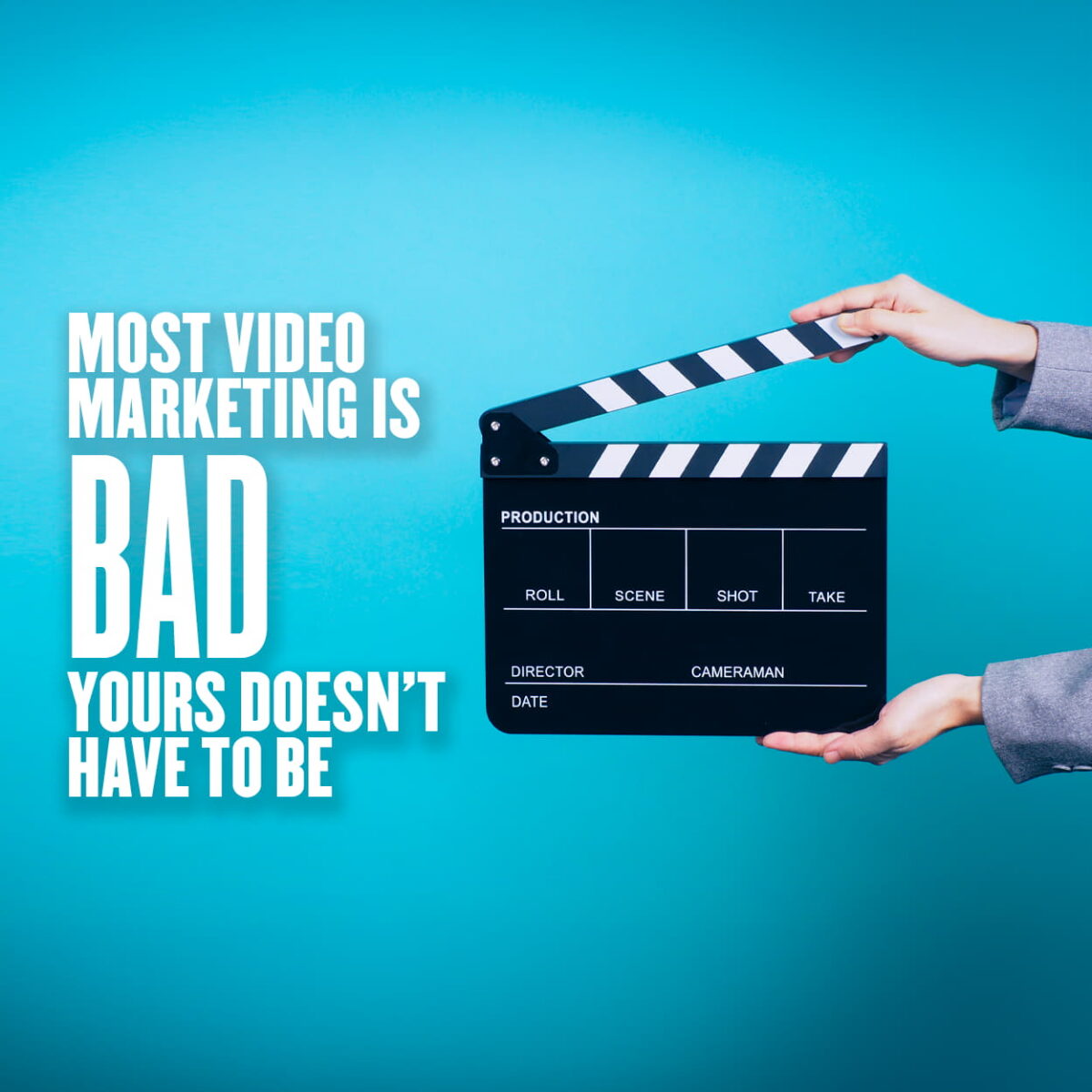
The honest answer, which the video production industry would probably prefer we didn’t think about much, is that most marketing video produced in this day and age is not very good. I don’t mean it’s technically bad. Technically it’s fine. The 4K is sharp, the audio sounds pretty decent, and the auto-generated captions are only occasionally hilarious. It’s just that almost none of the actual content of the video would be missed if it disappeared overnight.
That shouldn’t be looked upon as depressing, but as an opportunity. It means the bar for video that actually does something is much lower than the production volume suggests. So much of it is so bad, that creating something that’s remembered and generates a reaction isn’t as hard as the numbers may suggest.
The floor dropped, the ceiling didn’t move
For the past few years, AI has been quietly demolishing the production cost of anything that looks professional on screen. ElevenLabs will read a script in a passably persuasive voice for the price of a Flat White. Descript edits video by editing the transcript, with all the friction of using Microsoft Word. Runway or Sora or any of the half-dozen others will conjure passable B-roll from a text prompt while we make ourselves a BLT.
The agency pitch deck of 2019, the one that justified its $40,000 production budget by enumerating the rented gear, has aged into a curiosity. The kit is no longer the cost. The kit barely exists as a meaningful expense. Anyone with a new-ish phone, a $30 microphone from Amazon, and a few hours to spare can now produce video that, on a purely technical reading, is indistinguishable from work that cost five figures half a decade ago. But the bigger point here, is that none of this has made the average corporate video any more interesting to sit through. If anything, it’s had the inverse effect, because the marginal cost of producing forgettable content has collapsed to near-zero, and the marginal incentive to stop and think before pressing record has collapsed in sympathy. When making a video is cheap, the meeting that determines whether the video needed to exist in the first place becomes the first thing to get cut.
What we’re left with is a kind of background hum of content marketing that everyone’s vomiting out, but nobody watches. CEOs declaiming their corporate values at a slightly mis-framed camera. Customer testimonial videos shot in front of pull-up banners, in which the customer in question delivers their lines with the hostage-tape pacing of someone reading a script under duress.
The ceiling for video that materially shifts how a prospect feels about a business has, unfortunately, barely moved, while the floor has dropped to roughly zero. The gulf between these two positions is where almost every marketing video being produced right now is sitting, looking exactly like every other one.
Short-form ruined the first five seconds
If we’ve watched any TikTok, Reel, or YouTube Short in the past two years, and the answer is yes whether we choose to admit it or not, our tolerance for a slow opening has been silently recalibrated in ways we may not have consciously noticed. The first second of a short-form video has to earn the second second. The second has to earn the third, and so on. Anyone who has attempted to endure a corporate explainer that opens with a six-second logo sting set to royalty-free orchestral music has felt the recalibration as something close to physical discomfort. The thumb wants to scroll. The brain wants to scroll. Only some residual sense of professional courtesy keeps the video playing.
This is not really a question of short-form being a “format” companies need to “adopt”, which is how the trade press tends to frame it. It’s a question of what watching a few hundred million short-form videos has done to the attention budget of every adult with a phone, which is to say, every adult. The opening of any video, including long-form material whose value rewards a slower build, is now being assessed against a baseline established by people whose entire vocational existence is given over to nailing the first three seconds.
Behavioral scientists call this a shifting reference point. We don’t compare corporate videos to other corporate videos any more. We compare them, however unconsciously, to whatever video we watched most recently, and the most recent video is almost certainly something produced for nothing by a 22-year-old in a bedroom with a sharper grasp of pacing than the agency hired to shoot the company explainer.
The bit where the agency tells you the answer is more video
You’d expect, at this point in an article on a marketing agency’s website, the writer to pivot smoothly into the recommendation that what every business really needs is more video. Specifically with us. Probably with a Contact button at the bottom of the page. But here’s where I’m going to disappoint you. My honest recommendation, the one a self-interested agency would never put in writing, is that most businesses currently making marketing videos should make fewer of them and think about each one for considerably longer. A volume problem is not solved by adding more volume.
The handful of videos that actually work (and they do exist) tend to share a couple of features that have nothing whatsoever to do with production budget. They have a recognizable point of view. They were made by people who clearly cared, in a way the audience can feel, whether anyone watched. And they tend to dispense with the closing CTA voiceover saying “to learn more visit our website at…”, because the entire video was the CTA. These kinds of things don’t cost any money. They cost thinking, which is rarer and much harder to procure than camera time. AI has driven the price of production down close to zero. It has done nothing whatsoever to the price of having something worth saying, which remains stubbornly high.
Sales teams have been quietly outflanked by this
In-house marketing departments have spent the past two years arguing about TikTok strategy in increasingly heated quarterly meetings. Meanwhile, the most interesting commercial application of video over the same period has been happening in sales, mostly without the marketing department’s knowledge or involvement.
Sales professionals worked out, somewhere around 2022, that a 90-second Loom recording walking a prospect through a specific question is worth vastly more than an hour-long “Discovery Call”, because the prospect can watch it on their own time and forward it to the three other people on the buying committee who never agreed to be on the call in the first place. The same logic applies, in reverse, to video case studies that don’t try to mimic the opening of the Olympics. A short, badly-lit, off-the-cuff video of an actual customer answering an actual question outperforms the glossy version more or less every time, because it looks like the kind of artifact a real person would film at their desk, and the prospect’s defensive sniff-test for “marketing” doesn’t fire.
The underlying principle here is one of the more reliable findings in behavioral economics applied to marketing. Roughness and imperfection signal authenticity, and authenticity is now in considerably shorter supply than production polish.
The money is still moving toward video, just not the kind you’d expect
The economics underneath all of this are pretty wild. According to the IAB’s 2025 Digital Video Ad Spend report, US digital video advertising reached $72.4 billion in 2025, growing roughly three times faster than total media spend, and is projected to clear $80 billion in 2026. Digital video now captures close to 60% of all US TV and video advertising budgets, up from 29% in 2020. The money, in other words, has already decided where it intends to go. What’s worth noticing is where, inside that figure, the growth is actually happening. Connected TV is pulling the majority of it, with social video and short-form vertical formats absorbing most of the remainder. The traditional pre-roll YouTube ad and the talking-head LinkedIn post are flat or declining. The video advertising market is expanding because the formats that now command attention are categorically different from the ones that used to.
For most small businesses and startups, the practical implication is that “doing video” is not a single decision so much as a sequence of them, each one concerning what specific kind of video should exist and what particular piece of commercial work it is genuinely meant to perform. We need to fess up and stop with this fantasy workflow of repurposing one piece of content across every channel, and acknowledge the fact that a 30-second vertical short and a 12-minute YouTube deep dive are different objects, made for different reasons, for people who think about them in fundamentally different ways.
Going to the supermarket and buying the same ingredients as a Michelin-starred chef won’t make me Gordon Ramsay. At best, it gives me a frustrating and expensive way to ruin a Tuesday evening. The version of this problem that applied to broadcast-quality video equipment in 2008 has not gone away in the intervening 18 years. It has simply migrated up the stack, from cameras and lighting rigs to AI models and editing software.
The kit is now a clutch of AI tools and editing platforms anyone can subscribe to. The ingredients are essentially free. The cooking, which remains the only part of the process nobody has yet found a way to outsource to a model or a SaaS subscription, still requires someone who knows what the finished dish is supposed to taste like. Spend any time on LinkedIn and we’ll find serious quantities of beautifully-shot and entirely pointless video being served up in what is functionally a dog bowl.
Embracing video today doesn’t mean racing to add more of it to a content calendar that nobody, including the people who built it, finds particularly compelling. It means being prepared to make less of it, but more deliberately, with a clear and specific sense of why anyone would bother to watch it. If we can help with that, we’d be happy to talk. If we can’t, that’s fine too, because nobody needs yet another forgettable video.
ABOUT THE AUTHOR

Gee Ranasinha is CEO and founder of KEXINO. He's been a marketer since the days of 56K modems and AOL CDs, and lectures on marketing and behavioral science at two European business schools. An international speaker at various conferences and events, Gee was noted as one of the top 100 global business influencers by sage.com (those wonderful people who make financial software).
Originally from London, today Gee lives in a world of his own in Strasbourg, France, tolerated by his wife and teenage son.
Find out more about Gee at kexino.com/gee-ranasinha. Follow him on on LinkedIn at linkedin.com/in/ranasinha or Instagram at instagram.com/wearekexino.
Recent articles:
Why Business Still Worships Effort (And How It’s Quietly Killing Strategy)

The “Brand vs. Activation” Debate Is a Capital Allocation Failure

How Behavioral Science Thinking Improves Marketing Effectiveness

Dark Social: The Hidden Conversations Marketers Can’t See

Marketing In A Recession: How To Weather The Storm

How To Convince A Marketing Skeptic